







Every business in the Philippines that holds inventory for sale, whether in manufacturing, retail, wholesale, real estate, or construction, must submit an annual inventory list to the Bureau of Internal Revenue (BIR). The deadline for calendar-year companies is January 30, 2026, and failing to comply can result in penalties of up to ₱25,000 per year plus surcharges. Companies that follow a non-calendar reporting period should adjust their submission date accordingly, generally 30 days after the fiscal year-end.
This guide covers everything you need to prepare and submit your BIR inventory list for Taxable Year 2025: who must file, what formats to use (Annex A, B, C), how to submit through the TRRA Portal, what penalties apply for late filing, and a practical step-by-step preparation checklist based on current BIR regulations including RMC No. 8-2023, RMC No. 66-2024, and the implications of RMO No. 1-2026. Understanding how periodic inventory reporting systems tie together helps ensure your submissions align with BIR expectations from the start.
Key Takeaways
|

What is the Inventory List?
The BIR inventory list is a sworn declaration of all goods, materials, and merchandise your business holds, whether for sale, in production, or stored as raw materials, as of a specific reporting date (usually December 31 for calendar-year filers). Its legal basis comes from Section 236 of the National Internal Revenue Code (NIRC), reinforced by RMC No. 57-2015 and updated submission procedures under RMC No. 8-2023.
The inventory list is not just a compliance formality. The BIR uses it as a cross-referencing tool during audits, matching the figures you report against your books of accounts, Audited Financial Statements (AFS), and Annual Income Tax Return (ITR). Under the newly issued RMO No. 1-2026, the inventory list is now explicitly part of the standardized audit checklist (Annex B), meaning examiners are required to verify it in every single-instance audit. If the numbers don’t reconcile across these documents, it raises a red flag that can trigger an expanded audit.
Who Must Submit?
Not every registered business is required to file an inventory list, but the threshold catches more companies than most people expect. Under BIR regulations, submission is mandatory for businesses with a tangible asset-rich balance sheet, defined as having 50% or more of total assets classified as working capital assets (accounts receivable, inventory, and similar current assets).
In practice, this covers nearly all businesses in the following industries:
- Manufacturing — raw materials, work-in-process, and finished goods
- Merchandising and Retail — goods purchased for resale
- Wholesale and Distribution — stock held across warehouses
- Real Estate — land, housing units, and lots held for sale (reported under Annex B-1)
- Construction — materials and supplies allocated to ongoing projects (reported under Annex C)
Important edge case: Even if your business has zero inventory on December 31, you are still required to submit if you held inventory at any point during the taxable year. Submitting a nil report is better than not submitting at all. For companies with multiple branches, the TRRA Portal allows consolidated submission; you don’t need to file separately per branch (per RMC No. 66-2024 guidelines)
When Should the Inventory List Be Submitted?
Businesses in the Philippines holding inventory must submit an annual inventory list to the BIR. For calendar-year companies, the deadline is January 30, 2026. For non-calendar year businesses, submission is due 30 days after the fiscal year-end.
Failure to comply can result in penalties up to ₱25,000, along with surcharges. Use the TRRA Portal for digital submission, and ensure accuracy to avoid audits or additional penalties. Preparing in advance and following the correct format is key to smooth compliance.
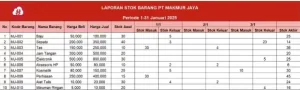
Additional Reporting Requirements
The BIR requires businesses to submit their inventory list using different annex formats based on their industry.
- Annex A: Used by manufacturing, merchandising, and retail businesses. This format includes raw materials, work-in-progress (WIP), finished goods, and goods for resale. It requires specific details such as product codes, location, and valuation methods.
- Annex B-1: Specifically for real estate and property developers. This format includes land, housing units, and lots held for sale. It focuses on property identifiers, such as TCT/CCT numbers and zoning classification.
- Annex C: Applied by construction businesses. This annex covers materials and supplies allocated to ongoing projects, with project-level details such as project names, contract references, and the percentage of completion.

Compliance & Penalties for the Inventory List BIR Every Business Should Know
Failing to submit the inventory list on time results in a penalty of ₱1,000 per failure, with a maximum of ₱25,000 per year per type of return, as outlined under NIRC Section 250.
Additionally, discrepancies found during audits can lead to surcharge penalties:
- 25% for late or incorrect filing
- 50% for willful neglect or fraud
Interest at 12% per annum may also apply on any deficiency amount.
When Should the Inventory List Be Submitted?
For businesses with a fiscal year different from the calendar year, the inventory list must be submitted within 30 days after the end of their fiscal year. This means companies should adjust their submission date based on their specific fiscal year-end to ensure timely compliance with BIR regulations.
Compliance and Penalties: What’s at Stake
Direct Penalties Under NIRC Section 250
Failing to submit the inventory list on time is classified as a failure to file an information return under the National Internal Revenue Code. The penalty is ₱1,000 per failure, with a maximum of ₱25,000 per calendar year per type of return. This applies regardless of whether there’s an actual tax deficiency; it’s a flat administrative penalty for non-compliance.
Tax Deficiency Consequences
The bigger risk isn’t the ₱1,000 fine; it’s what happens when the BIR finds discrepancies during an audit. If the examiner determines that your inventory figures are misstated and this results in underpayment of income tax or VAT, the following apply on top of the basic tax due:
- Surcharge: 25% for late or incorrect filing; 50% if the BIR determines willful neglect or fraud
- Interest: 12% per annum on the deficiency amount (subject to adjustment based on BSP reference rate)
- Compromise penalty: A negotiable amount based on the BIR’s published Schedule of Compromise Penalties, often used to settle without a full formal assessment
How Inventory Errors Lead to Tax Problems
Overstated inventory directly distorts the link between stock figures and your cost of goods sold, which can lead to understated taxable income and trigger an audit. Here’s how common errors play out:
- Overstated inventory → inflated ending inventory → understated COGS → overstated net income → potential excess tax payment (or, if the BIR catches it going the other direction, an underpayment assessment)
- Understated inventory → understated ending inventory → overstated COGS → understated net income → underpayment of income tax and VAT
- Inconsistency between inventory list and AFS → BIR examiner raises an audit query → investigation expands to cover all tax types under the new single-instance audit framework (RMO No. 1-2026)
Many of the mistakes that commonly lead to BIR scrutiny stem from mismatches between what’s on the inventory list and what’s in the financial statements. If you’re already running your books through a BIR-accredited digital system, make sure the data it generates is fully consistent with the inventory list you submit. Ignoring the compliance requirements for BIR-registered point-of-sale machines can compound your issues and lead to additional penalties on top of inventory list violations
Your submission needs to follow a format that the BIR will actually accept, with each line item covering the required fields. Below is the standard Annex A structure used by manufacturing, merchandising, and retail businesses: The method you use to assign cost to each item matters; the BIR expects it to be consistent with your audited financial statements. Here’s a quick breakdown: Understanding how FIFO, weighted average, and other approaches differ in practice helps you choose a policy that aligns with your financial statements and holds up under audit. Whatever method you use, the critical rule is consistency — switching methods between years without disclosure and justification will raise questions during examination. Keeping your warehouse records clean and organized year-round simplifies BIR reporting and saves you from last-minute reconciliation headaches every January. The inventory list covers only items that form part of Cost of Goods Sold (COGS) or Cost of Sales. Exclude the following: Keeping these records accurate throughout the year is what makes January 30 filing straightforward or stressful. Businesses that track stock manually often find their year-end data inconsistent, especially when multiple warehouses or product lines are involved. A fully integrated ERP solution keeps item descriptions, quantities, and valuations updated automatically, so pulling your year-end figures takes minutes rather than weeks. Once your inventory data is ready and saved in the prescribed format on a DVD-R or USB flash drive, the next step is choosing how to submit it to the BIR. As of 2024, hard copy submission has been removed — all submissions must now be in soft copy. There are three accepted methods, each with its own advantages depending on your business setup: This is the BIR’s preferred method as of RMC No. 66-2024. Here’s exactly how to do it: Cross-check tip: If your business is already enrolled in the BIR’s digital invoicing program, double-check that your e-invoice data reconciles with the inventory figures you’re reporting. Similarly, businesses filing sales data electronically through the BIR portal should cross-check those numbers against the inventory list to avoid red-flag discrepancies during audit
Download BIR Inventory List Template You can submit your inventory report and/or notice in one of these ways: These rules came into effect on June 14, 2024, after being published on the BIR’s website. Doing an actual hands-on count of everything in your warehouse is the foundation of an accurate BIR inventory list — estimation or system-only figures won’t hold up under audit. Here’s a practical timeline to keep your team on track. Before counting, consider sorting your stock into A, B, and C tiers based on value so your team spends extra verification effort where it matters most. High-value “A” items (typically 10–20% of SKUs representing 70–80% of total inventory value) should be double-counted by a separate team. After finalizing your count, reconcile the results against what you carried over from last year’s closing balance to identify and document any variances. This is where errors surface — and where your documentation matters most. Looking at how your stock moved throughout the year post-count helps flag slow-moving items and valuation write-downs you need to record before submission In early 2026, the BIR issued Revenue Memorandum Order No. 1-2026, which overhauls the bureau’s audit framework. While the order covers all types of tax examinations, it has specific implications for businesses that file inventory lists. Under the old framework, multiple audit teams could issue separate electronic Letters of Authority (eLAs) covering different tax types for the same taxable year. RMO No. 1-2026 replaces this with a Single-Instance Audit Framework, one eLA per taxable year, covering all internal revenue taxes simultaneously. This means the examiner reviewing your income tax will also be looking at your VAT, withholding taxes, and supporting documents like the inventory list in a single, consolidated examination. The inventory list is now included in the standardized audit checklist (Annex B of RMO No. 1-2026). This means examiners are specifically required to: Under the new risk-based selection criteria, businesses showing an underdeclaration of sales or income of 30% or more become priority audit targets. An inventory list that doesn’t match your financial statements is one of the easiest ways for the BIR to identify that gap. Treat the inventory list as an integral part of your overall tax compliance package — not a standalone filing you handle separately. Make sure the figures on your inventory list, books of accounts, AFS, and ITR all tell the same story. If there’s a legitimate reason for a difference (e.g., post-year-end adjustments), document it thoroughly. Beyond inventory, the new audit framework also scrutinizes withholding tax accuracy. Make sure your payroll reflects the latest withholding tax brackets you should be applying this year to avoid compounding your audit exposure The BIR prescribes different reporting formats depending on your industry. Using the wrong annex or mixing formats is a common mistake that delays processing. For retail businesses, keeping track of fast-moving SKUs across multiple store locations throughout the year makes Annex A preparation significantly easier when January comes. If you’ve been maintaining clean records per branch, generating the Annex A file becomes a matter of exporting, not rebuilding from scratch. Pharmaceutical businesses face additional complexity because they must track expiry dates, lot numbers, and lot-based valuation for FDA compliance in addition to BIR requirements. Systems built specifically for drugstore and pharmaceutical compliance can automate these unique requirements so you don’t have to maintain parallel tracking sheets. All taxpayers are required to submit a soft copy alongside the hard copy, stored on a USB flash drive or DVD-R (not CD-R). Key formatting rules: Alongside the inventory list itself, you must submit a Notarized Certification (Annex D) signed by the owner, president, or authorized officer, declaring that: To illustrate how things can go wrong, here’s a realistic scenario based on common compliance issues BIR examiners encounter. Scenario: A mid-sized retail business with three branches in Metro Manila The company uses a perpetual inventory system in its ERP, but only performs a physical count once a year in late December. During the count, they discover several problems: The takeaway: Most inventory list problems aren’t caused by not knowing the rules — they’re caused by rushing the process in January. An 8-week preparation timeline (see section above) eliminates nearly all of these issues. The BIR inventory list is one of those compliance requirements that feels deceptively simple until you’re scrambling to reconcile numbers at midnight on January 29. The businesses that handle it smoothly are the ones that treat it as a year-round process rather than a once-a-year deadline. Here’s a quick recap of what makes a clean, audit-ready submission: With the introduction of RMO No. 1-2026 and its single-instance audit framework, the stakes for getting this right are higher than before. A well-prepared inventory list isn’t just about avoiding penalties — it’s about reducing your overall audit risk. Picking the right tool for your warehouse and accounting needs can help maintain accuracy and simplify reporting when submission deadlines approach. Having one platform that connects your warehouse, accounting, and compliance data helps maintain accurate records year-round — so BIR submission becomes routine, not a fire drill.
Frequently Asked Questions (FAQ) about the Inventory List of BIR The inventory list for BIR is an official record that provides a detailed breakdown of a company’s inventory at the end of the fiscal year. It’s required to ensure accurate reporting for tax purposes. Yes, the BIR allows digital submissions, but the format and labeling must adhere to their requirements. HashMicro’s Inventory Management System automates inventory tracking, provides customized reports, and offers reminders for compliance deadlines, making it easier to prepare an accurate BIR-compliant inventory list. Aside from that, HashMicro also provides BIR POS and accounting software for end-to-end business processes. Items such as office supplies, capital assets, and depreciated assets should not be included as they do not qualify as inventory.
What to Include in the BIR Inventory List

Column
Description
Example
Item Description
Name or nature of the goods
White Portland Cement 40kg
Product / Inventory Code
Internal SKU or item code
WPC-40K-001
Location (Address + Code)
Warehouse or branch where the item is stored
Warehouse A, Pasig City — Code 03
Inventory Valuation Method
FIFO, Weighted Average, or LCNRV
FIFO
Quantity in Stocks
Units on hand at reporting date
2,500
Measurement
Unit of measure (pcs, kg, liters, etc.)
Bags
Total Weight / Volume
Aggregate quantity
100,000 kg
Unit Price
Cost per unit based on chosen valuation method
₱285.00
Total Cost
Quantity × Unit Price
₱712,500.00
Remarks
Notes on condition, expiry, or slow-moving status
Expires March 2026
Valuation Methods: Which One to Use
What NOT to Include
How to Submit: Three Methods
Method
Pros
Cons
TRRA Portal (Recommended)
Digital trail, consolidated multi-branch submission, automatic email confirmation to RDO
Maximum 4MB per file; requires a stable internet connection
Email to RDO
Flexible submission; follows standard email attachment limits
No automatic confirmation; requires manual follow-up
Manual / In-Person Submission
Stamped receiving copy issued immediately
Time-consuming; requires a physical visit to the RDO
TRRA Portal Step-by-Step Walkthrough
Step-by-Step: How to Prepare Your BIR Inventory List
8-Week Preparation Timeline
Week
Phase
Key Actions
Week -8 (Early Nov)
Plan
Set count date, notify external auditor, assign team leads per zone/warehouse
Week -6 (Mid Nov)
Prepare
Print count sheets or configure barcode scanners; train counters on procedures
Week -4 (Early Dec)
Clean Up
Organize warehouse layout, label zones clearly, and resolve known system discrepancies
Week -2 (Mid Dec)
Tag
Pre-label slow-moving and serialized items; print count tags for high-value stock
Day 0 (Dec 31)
Execute
Conduct full physical count; supervisor spot-checks begin immediately
Day 1–3 (Jan 1–3)
Reconcile
Match count sheets to perpetual records; investigate and document variances
Day 4–10 (Jan 4–10)
Finalize
Post adjustment journal entries; generate Annex A/B/C files; prepare soft copy
Day 11–20 (Jan 11–20)
Submit
Upload via TRRA Portal or deliver to RDO; retain stamped copy or email confirmation
Physical Count Best Practices
Post-Count Reconciliation
How RMO No. 1-2026 Changes the Game for Inventory Compliance
What Changed
Why It Matters for Your Inventory List
The Takeaway
BIR Inventory List Format by Annex Type
Annex
Industry
What It Covers
Key Differences from Annex A
Annex A
Manufacturing, Marketing, Retail
Raw materials, WIP, finished goods, goods for resale
Standard format — includes product code, location, valuation method, and unit price
Annex B
Real Estate and Property Developers
Land for development, housing units for sale, subdivision lots
Uses property identifiers (TCT/CCT number, lot area, zoning classification) instead of product codes
Annex C
Construction Contractors
Materials and supplies for ongoing projects
Requires project-level allocation: project name, contract reference, % completion, allocated cost
Soft Copy Requirements
Annex D — Notarized Certification
Common Mistakes to Avoid

Conclusion
What is an inventory list for BIR?
Can I submit the inventory list digitally?
How can HashMicro help with inventory list compliance?
What should not be included in the BIR inventory list?